
Play Alquerque Online vs AI
How to Play Alquerque
Alquerque looks like a smaller draughts set right up to the moment a jump is forced. Do you take the centre crossing, keep the back rank covered, or pass on a leap that lets the opponent chain back? This version lets you play through those choices against multiple AI levels, then review them with hints, undo, and replay.
Where It Comes From
Alquerque, also called al-qirkat, was played in the medieval Middle East and is the direct ancestor of draughts. Pieces sit on the 25 points of a 5×5 lattice, not on squares, and they only travel along the drawn lines. The version most people use today comes from Alfonso X's thirteenth-century Book of Games, not from later 8×8 checkers with kings. That is the ruleset this site follows. Instead of leaving those ideas on a separate rules page, we put them directly into play: points not squares, steps along marked lines, jumps you must take, and pieces that never promote. The AI levels, hints, undo, and replay are here to help you learn that ancestor by playing it.
Play on the Points
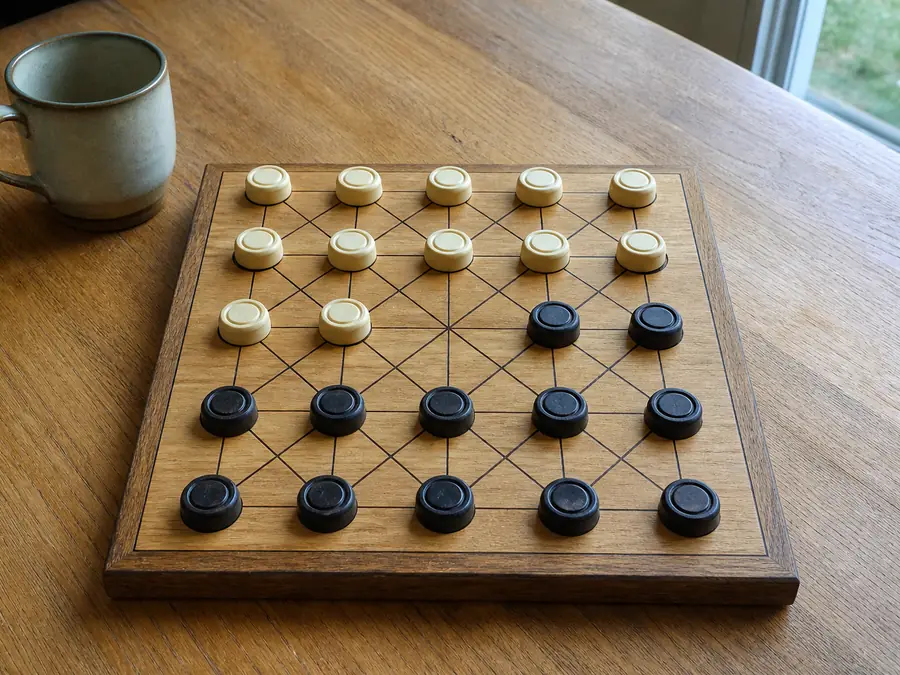
Do not hunt for chessboard squares. Alquerque uses twenty-five intersections joined by orthogonal lines and a lattice of diagonals. The first move often steps into the centre, which can be leapt on the reply, so the opening is already about jumps.
If You Can Jump, You Must
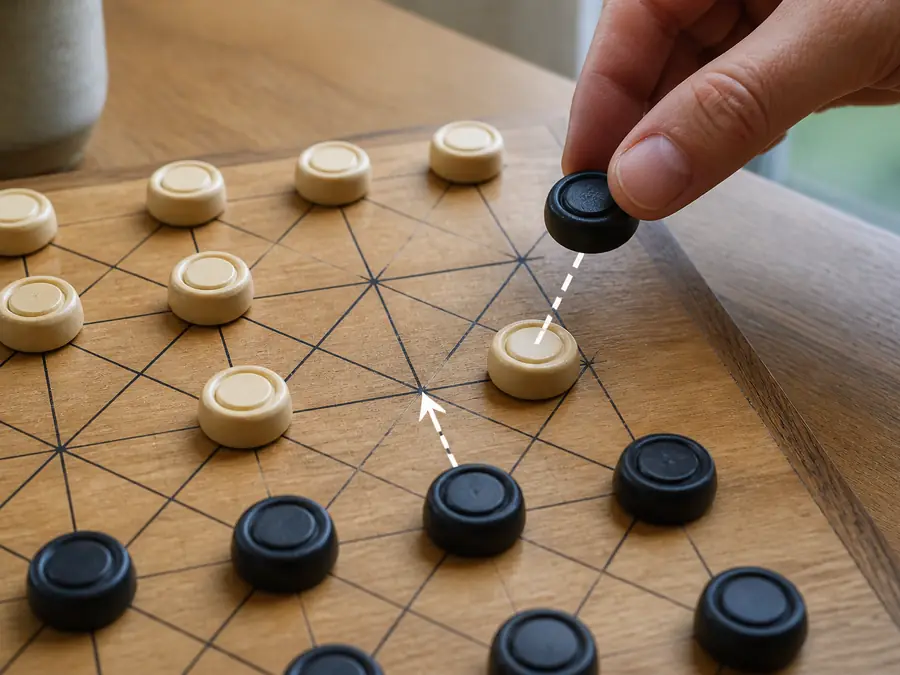
When any capture exists, quiet steps disappear. A leaping piece keeps leaping while fresh landings remain. Pieces never promote: once a piece reaches the far rank, it may only move to capture.
Hints Follow Your AI Level
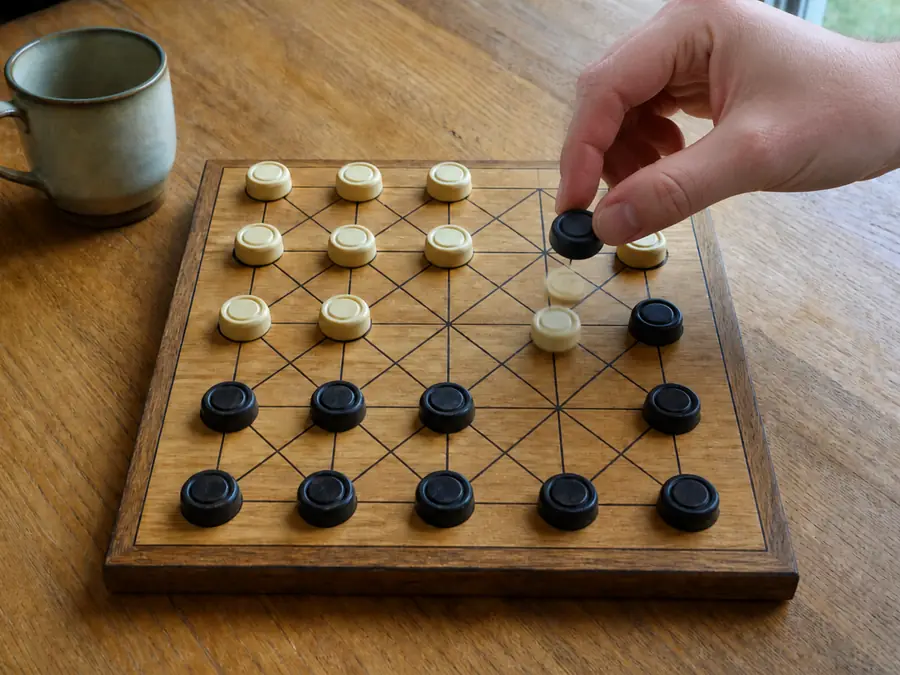
Choose from multiple AI levels, then play as Black to open or White to reply. Hints use the same level, and undo rewinds both your move and the AI response. After the game, replay the turn when a jump was missed. All AI calculation stays in your browser.
25points on the lattice
12pieces a side
Linessteps and jumps
Jumpcaptures are forced
Common questions
Is Alquerque the same as Chinese checkers or the draughts on a square board?
No. Chinese checkers on a star board is a race to move all your pieces across. International draughts on 8×8 or 10×10 squares lets men promote to kings. Alquerque uses twenty-five points on a 5×5 lattice, moves only along the drawn lines, and pieces never promote. This site follows the ancestor rules recorded in Alfonso X's Book of Games.
I want a quiet step, so why does the move not count?
Usually because a jump capture is still on the board. If any of your pieces can leap, you cannot play a non-capturing step instead. Find which piece can jump and where it can land, tap the piece, then tap the landing point. If the same piece can keep leaping in one turn, you must finish the whole chain before the turn ends.
Several jump lines are legal. Can I choose the one I prefer?
Yes. This board does not use the international draughts rule that forces the longest capture. Any legal jump is allowed, even when another line eats more pieces. In practice opponents often leave a single jump to pull you into a follow-up chain, so it is worth tracing the rest of the sequence before you commit.
Does a piece become a king when it reaches the far rank?
No. Alquerque has only one kind of piece. After Black reaches the top row or White reaches the bottom row, that piece can no longer take a quiet step along a line. It keeps moving only by jumping. If no jump exists, it simply stays on the back rank.
When does the game end in a draw?
If forty half-moves pass with no capture, the rules call it a draw. That often happens in cramped endings where both sides still have pieces but neither can force a win. In an online room you can also offer a draw, and the game ends if your opponent accepts.
Does the hint follow the AI level selected in the sidebar?
It does. The hint uses the same search as the level you picked; it does not secretly switch to the strongest setting. A useful habit is to choose a move yourself first, then open the hint and compare. If they differ, undo back to the branch and try both ideas.
Can I play without signing up or installing anything?
Yes. Open the page on a phone or computer and move. There is no account, email, or password. Adding the site to your home screen is optional, and you can finish a full game without installing an app.
Against the AI, can I play as Black or White?
Yes. Black always moves first. As Black you open; as White the AI plays the first move. Switching sides mid-game starts a fresh board, and the pieces in play do not stay. The site asks for confirmation before it resets. In an online room you choose your color when you create it.
If I close the page, is my game against the AI still there?
On the same device, yes. Games against the AI and on one shared device are stored in this browser, with separate saves for playing as Black and as White. Change phones, change computers, or clear this site's data, and those games are gone. Online play depends on the room link; after a short disconnect, reopening usually returns you to the same seat.
Can I use hints and undo when I play with a friend on one device or online?
On one shared device you can undo and replay the move list, which helps when you want to pause and talk through a line, but there is no hint so neither side gets an answer handed to them. Online, once a move is accepted it is sent to the other player: no hint and no one-sided undo. You can resign, or offer a draw if you want to stop.
